
our approach
3D Mine-Scale Ventilation Simulation (eCFD)
Beck Engineering’s enhanced computation fluid dynamics (eCFD) framework uses multi-GPU solvers, enabling sub-metre resolution to mine ventilation design and simulation.
Our Approach
Ventilation is critical in all underground spaces, becoming increasingly complex when considering temperature, gasses, dust, moisture and multi-scale geometries. Conventional ventilation simulation methods simplify the airflow physics, providing reasonable estimates for simple circuits.
CFD approaches have been applied to mining, but are typically limited in computational capacity, rendering them inefficient at mine scale. Building on decades of multiscale, multiphysics simulation expertise, Beck Engineering has developed the eCFD framework on the lattice-Boltzmann method (LBM). eCFD is a thermodynamically consistent ventilation simulator, coupling turbulent airflow, reacting multispecies gas transport and heat transfer.
| Solver | What it does |
|---|---|
|
Turbulent flow solver |
Airflow through drives, stopes, caves and porous muckpile |
|
Multispecies transport solver |
Reacting and turbulent mixing and diffusion of multiple gas species, including through porous media |
|
Heat transfer solver |
Heat carried with the flow and gas fields |
Sub-metre resolution results are achievable throughout all underground workings within a single mine-scale simulation. eCFD can be seamlessly coupled with Beck Engineering’s geomechanical, cave flow and hydromechanical simulations, capturing evolving geometries and changes to temperature, gases, dust, moisture and the transportation of these key parameters.
| Network models | Conventional CFD | Enhanced CFD (eCFD) | |
|---|---|---|---|
|
How it computes |
1D airway network (Kirchhoff’s laws) |
Global solve across the mesh |
Local, neighbour-to-neighbour updates (LBM) |
|
What you see |
One value per airway |
3D field, limited by mesh size |
Full 3D field across the mine |
|
Resolution |
Airway level |
Coarsened to span a mine |
Sub-metre, over 10+ km |
|
Physics |
Airway-level airflow, pressure, heat and gas balances |
Turbulence and transport, often simplified at mine scale |
Turbulence, porous media, multispecies gas and heat, closely coupled |
|
Hardware and scale |
Runs on a laptop |
CPU clusters; scaling limits |
Massively parallel multi-GPU |
|
Living digital twin |
Static snapshot |
Hard to sustain at mine scale |
Built for it, coupled to LR4–FS5 |
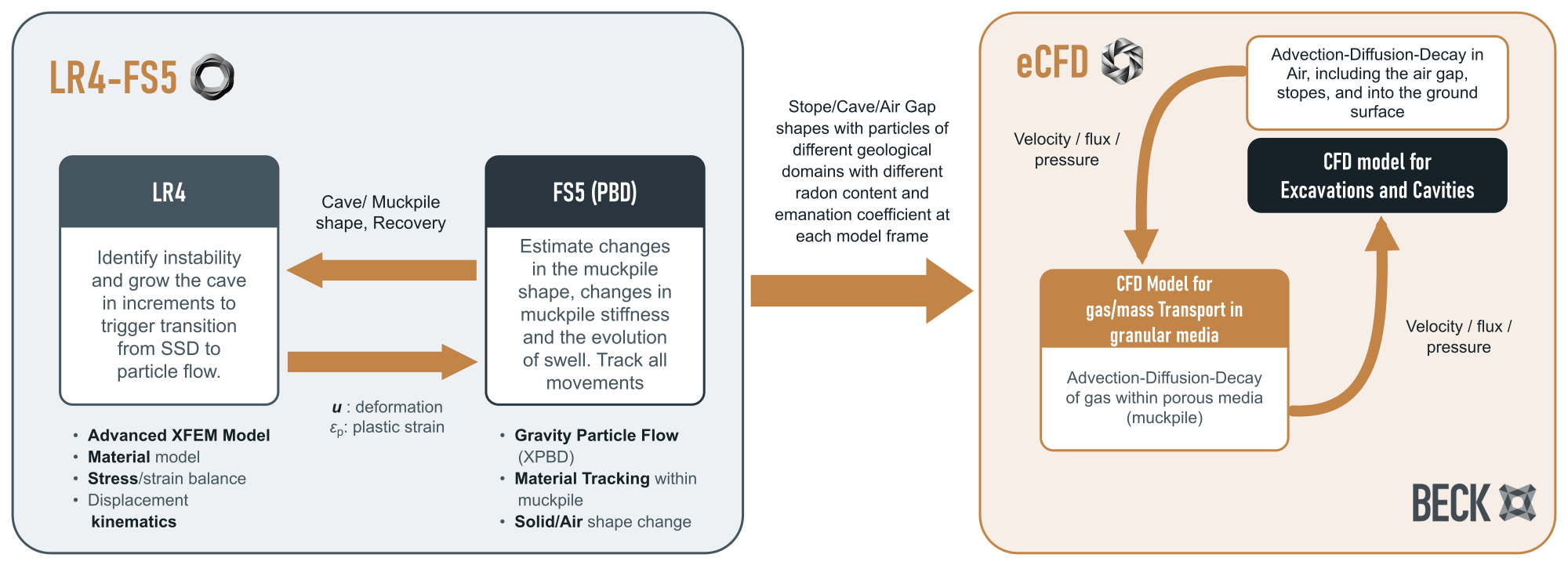
Geomechanics (LR4–FS5) supplies the evolving cave, air gap and muckpile geometry; eCFD returns velocity, flux, pressure, gas distribution and temperature, creating a living, mine-scale digital twin.
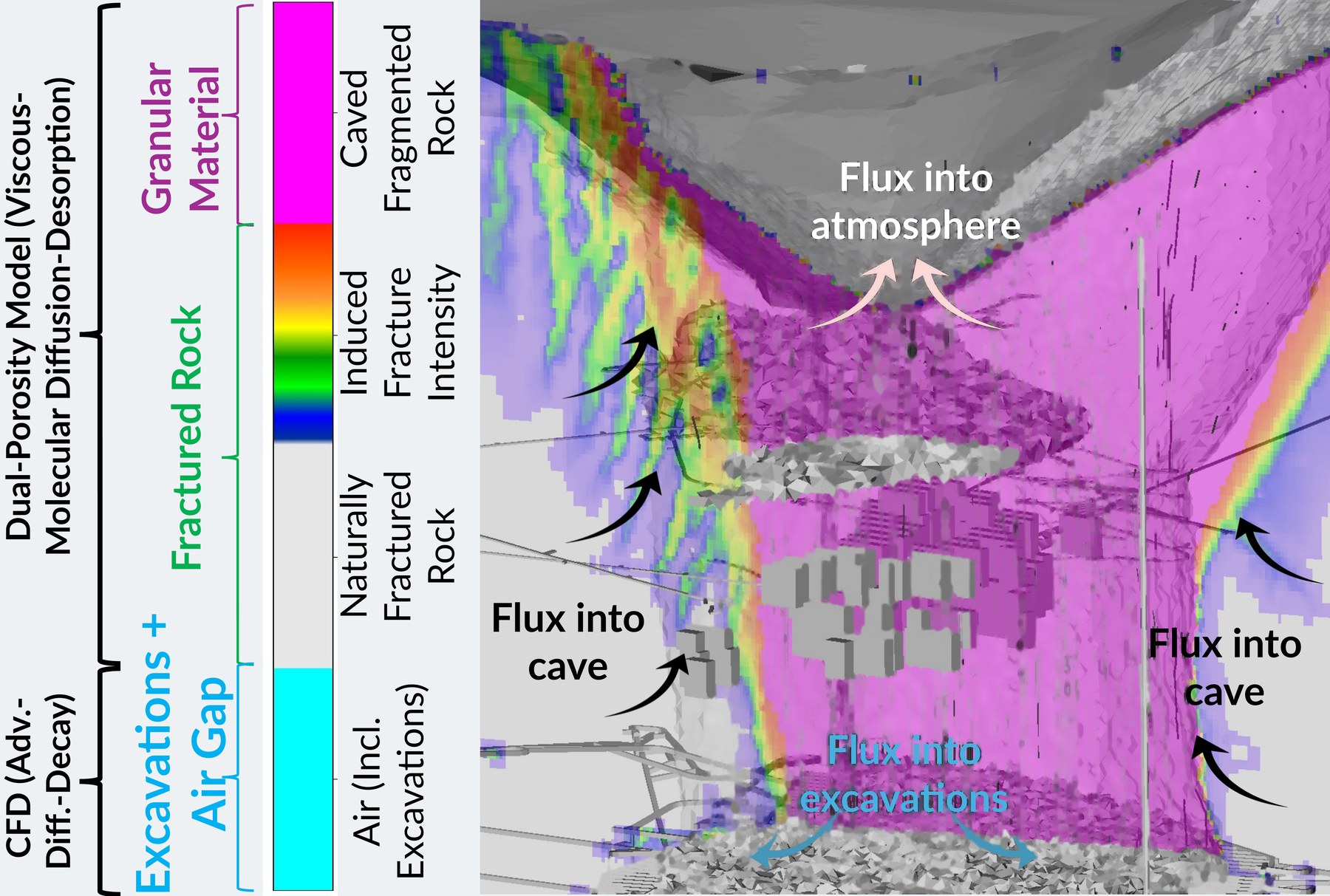
Multiscale physics considered across the cave and excavation system, from caved, fragmented rock to open air.
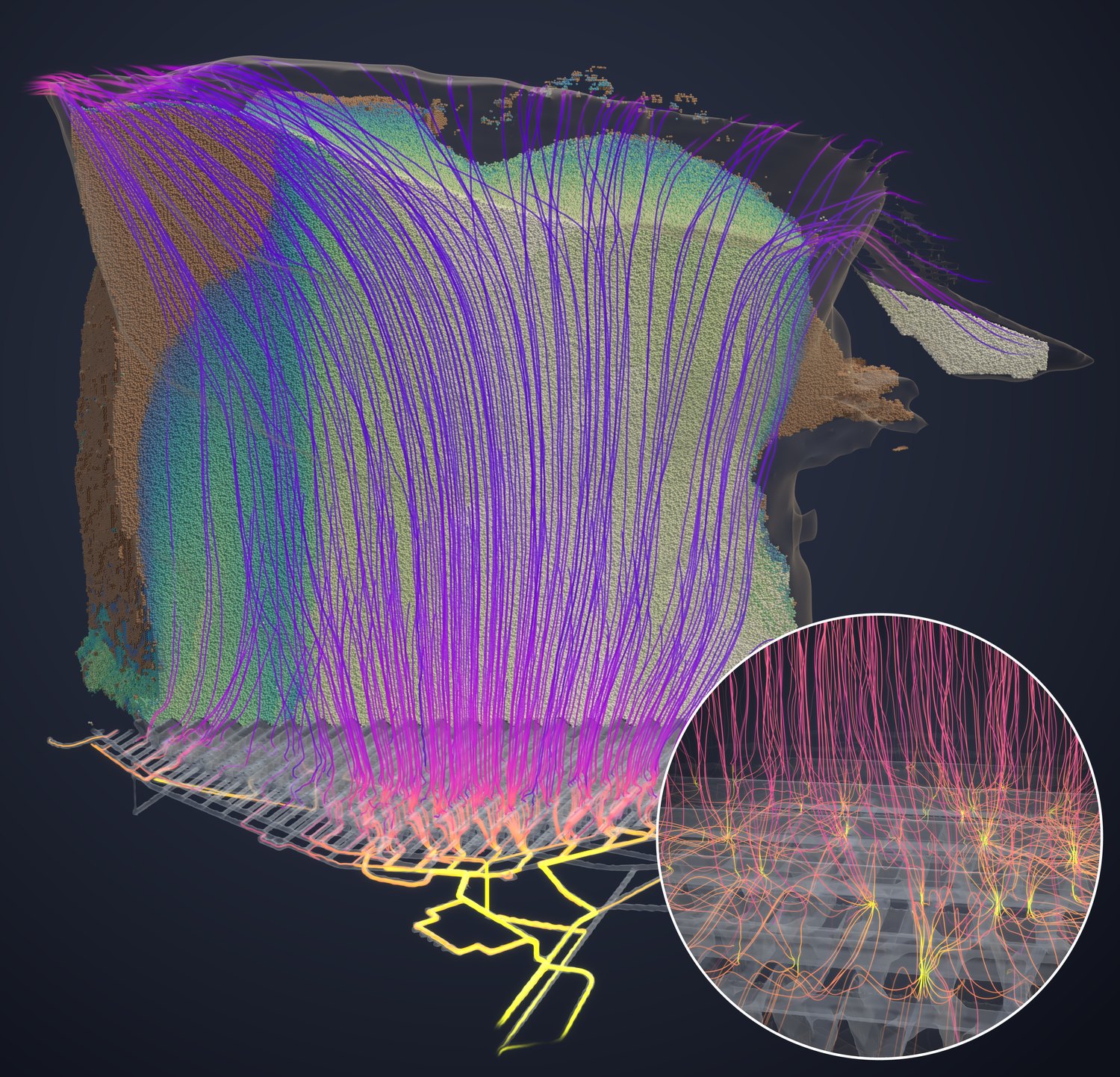
The cave breathing: modelled airflow drawn down through the caved rock and into the excavations.
Why mine-scale ventilation simulations?
- Ventilation system design. All ventilation circuit components such as fans, boosters and regulators can be considered in the simulation, allowing for rapid testing of ventilation design options.
- Coupled multi-physics. Nonlinear rock mass behaviour (LR4), cave flow, muckpile, air gap and fragmentation (FS5), and gas transport (eCFD) are solved on the same evolving geometry, closely coupled frame by frame.
- Complex 3D geometries. The entire mine is simulated, including vent rises, escape ways, crosscuts, declines, stopes and caves, revealing short-circuiting and fresh-air mixing when evaluating whether a working area is ventilated.
- Cave and excavation interactions. Transient fields show how airflow, gas and dust concentration can move between the extraction level drawpoints and the evolving air gap and muckpile volume, at every stage of the draw. The spatial variability of gas-generating muckpile can also affect the concentration within the mine, and consequently the adequacy of a ventilation design.
Block cave ventilation: caved-rock flow and mine air flow, modelled together.
Gas in a block cave: radon, blast fumes, fire smoke and diesel exhaust, carried by the mine’s airflow.